Phase II: Architecting Auditable Agentic Workflows
Applying NASA and IBM standards to build autonomous systems that function as true force multipliers.
The 3-Phase Framework
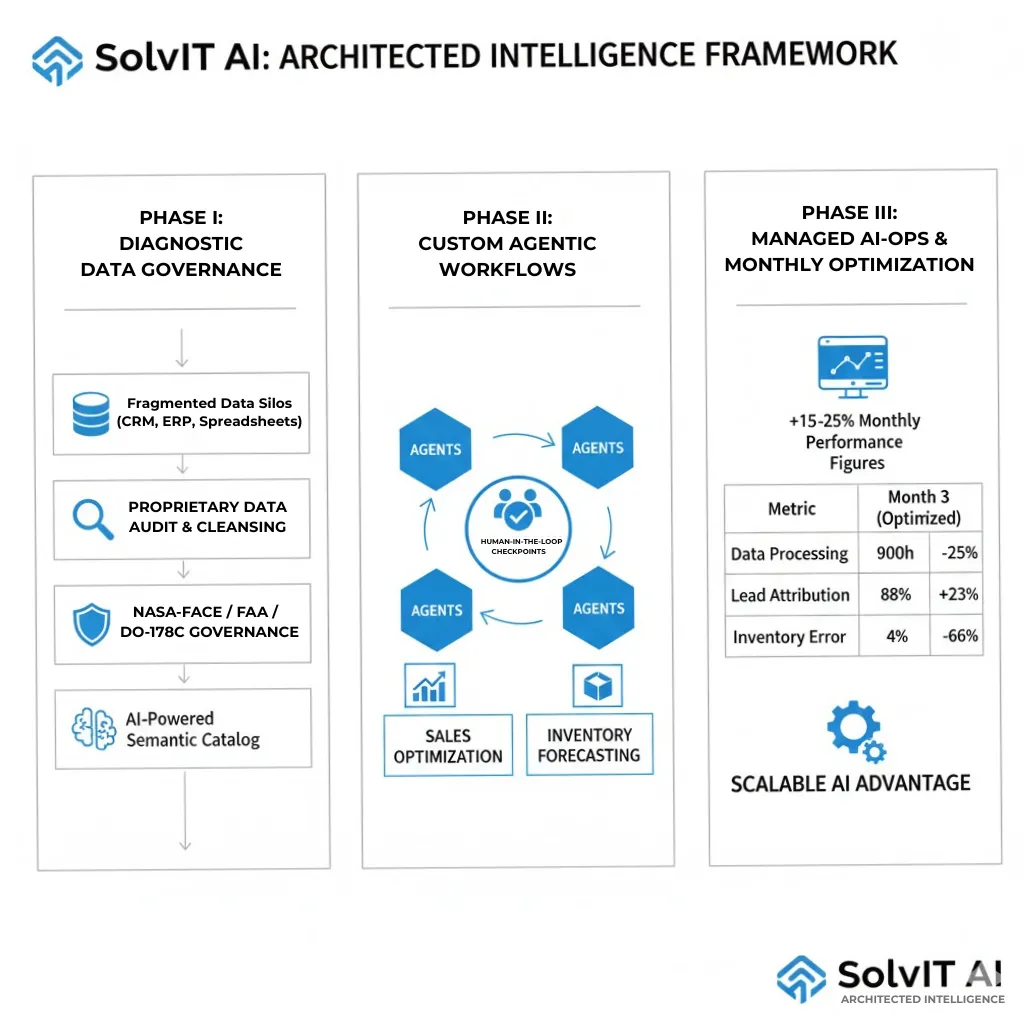
Building on the secure foundation of Phase I: Diagnostic Data Governance, the next step is mission-critical deployment. At SolvIT AI, we move beyond simple automation to build Custom Agentic Workflows—autonomous systems that act as true force multipliers for your team.
Beyond Black-Box Automation
Generic AI often fails because it lacks the context needed for high-stakes decisions. Our Agentic Workflows handle complex, multi-step tasks while saving specialized departments between 15 to 40 hours per month.
The "Human-in-the-Loop" Checkpoint
To ensure absolute accuracy, we embed Human-in-the-Loop (HITL) checkpoints into every workflow. This ensures that AI-driven decisions are always transparent, auditable, and scalable.
Bridging the Architectural Gaps
- Intelligent Synthesis: Link sales performance directly to marketing spend.
- Latent Pattern Recognition: Automatically detect operational anomalies.
- Predictive Intelligence: Forecast inventory and staffing requirements for future quarters.
What Makes an Agentic Workflow "Auditable"
Many automation vendors use the word "auditable" loosely. At SolvIT AI, auditable means a specific technical requirement: every agent action must produce a structured log entry containing the input state, the decision rule or model output that triggered the action, the action taken, the outcome observed, and the human escalation path if applicable. This isn't just good practice — it's a compliance requirement in regulated industries and a debugging necessity in all industries.
Non-auditable automation is a liability. When something goes wrong — and in production systems, something always eventually goes wrong — you need to be able to answer three questions: What did the agent do? Why did it do it? What should it have done instead? Without structured audit logs, those questions take weeks to answer. With them, minutes.
Industries That Benefit Most from Phase II Workflows
While agentic workflows deliver value across all industries, five verticals consistently see the fastest ROI — driven by the combination of high transaction volume, complex decision logic, and significant manual labor cost:
Financial Services
Loan processing, fraud triage, compliance monitoring, and customer onboarding — each involving rule-heavy workflows with significant exception handling. Typical time savings: 15–25 hours per employee per month.
Legal Services
Document review, contract extraction, research synthesis, and matter management. Our RAG-powered knowledge workflow for a national law firm reduced research time by 45% and achieved 98.5% retrieval accuracy.
Healthcare Operations
Prior authorization, patient intake, clinical documentation, and billing — workflows with strict compliance requirements that nonetheless benefit enormously from intelligent automation with human oversight.
Logistics & Distribution
Order processing, dispatch optimization, carrier management, and customer communication. Our agentic dispatch system reduced service latency by 70% for a mid-market logistics firm.
Manufacturing & Procurement
Supplier invoice processing, purchase order matching, quality control routing, and spend analysis. Organizations with high PO volume consistently achieve ROI within the first 90 days.
Phase II Implementation Timeline
Phase II builds on the data foundation established in Phase I. Organizations that arrive at Phase II with clean data, defined success metrics, and executive sponsorship in place can deploy their first production agentic workflow in 60–90 days. Here's what that looks like in practice:
- Weeks 1–2: Workflow Mapping. Document every step, decision point, and exception type in the target workflow. Identify the 70–80% "happy path" and the 20–30% exception classes. Define the HITL checkpoint criteria for each exception type.
- Weeks 3–4: Agent Architecture Design. Select the appropriate agent pattern (ReAct, Chain-of-Thought, tool-use), define the tool set and permission scope, and architect the audit logging schema. Review with compliance and security before build.
- Weeks 5–7: Build & Sandbox Testing. Develop the agent against production systems in read-only mode. Process a representative sample of real historical transactions and compare outputs to ground truth. Validate HITL checkpoints with domain experts.
- Weeks 8–10: Phased Production Rollout. Begin with 10–20% of live volume with parallel human review. Expand weekly as accuracy is confirmed. Full autonomous operation on the happy path by end of Week 10, with exception handling refined through real usage.
- Ongoing: Phase III Handoff. Structured handoff to Phase III Managed AI-Ops for continuous monitoring, retraining cadence, and performance optimization.
Common Phase II Deployment Risks and How We Mitigate Them
Every agentic workflow deployment carries risks that are manageable with the right architecture but catastrophic if ignored. Here are the four risks we see most frequently and how they're addressed in our Phase II engagements:
- Scope Creep in the Agent's Authority: Agents that start with narrow tool access gradually get expanded permissions as users discover new capabilities they want. Without explicit permission governance, an agent that started by reading databases ends up writing to them, sending external communications, and making financial transactions. Every permission expansion requires a security review and an audit log entry. We build this into the architecture from day one.
- HITL Bypass: Human-in-the-loop checkpoints only work if humans actually use them. If the approval interface is slow, cumbersome, or interrupts workflow, users route around it. We design HITL checkpoints to be approvals-in-context — a single-click approval within the system the user already works in, with the agent's reasoning and evidence presented clearly. Approval rates above 95% indicate the checkpoint is working; rates below 80% indicate users are finding workarounds.
- Integration Brittleness: Agents that call third-party APIs are vulnerable to upstream changes — field renames, authentication updates, rate limit adjustments. We wrap every external integration in a versioned adapter layer with circuit breakers and graceful degradation: if the upstream system is unavailable, the agent queues the work rather than failing silently or erroring out.
- Governance Debt Accumulation: As agents handle more volume, the exception cases that weren't anticipated in the original policy accumulate. Without a formal exception review process, the policy becomes inconsistent over time. We schedule monthly exception reviews as a formal deliverable in every Phase II engagement — reviewing what the agent escalated, why, and whether the escalation policy should be updated.
Scalable Professional Excellence
Phase II transitions your organization into Architected Intelligence, leading directly into Phase III: Managed AI-Ops for long-term ROI.
Key Takeaways
- Auditable means a specific technical requirement: every agent action must produce a structured log with input state, decision rule, action taken, outcome, and escalation path. Non-auditable automation is a liability.
- 5 industries with fastest agentic automation ROI: financial services, legal services, healthcare operations, logistics and distribution, manufacturing and procurement.
- 4 common deployment risks: scope creep in agent authority, HITL bypass, integration brittleness, governance debt accumulation. Each is manageable with the right architecture.
- Well-scoped Phase II deployments reach 70-85% autonomous operation in 60-90 days with measurable cycle-time and cost improvements from the first production week.
- Phase II builds on Phase I. Organizations that arrive at Phase II with clean data, defined metrics, and executive sponsorship move to production 40% faster.
Related reading: Phase I: Diagnostic Governance | Phase III: Managed AI-Ops | Agentic Automation Executive Briefing
Ready to deploy auditable AI agents?
Discover how custom workflows can save your team 15-40 hours per month.
Book Your Executive AI Audit →