MVP Med AI: The Complete Guide [2026]
93% of enterprise AI proofs of concept never reach production. Learn the AI MVP methodology that changes that equation — from hypothesis validation to measurable business impact in 30 days.
📋 Table of Contents
93% of enterprise AI proofs of concept never reach production. Not because the models failed — because the approach was wrong. An AI Minimum Viable Product (MVP) built with the right methodology changes that equation entirely. This guide covers what an AI MVP actually is, when to build one, the five mistakes that sink most projects, and how to go from hypothesis to validated business impact in 30 days.
What Is an MVP Med AI?
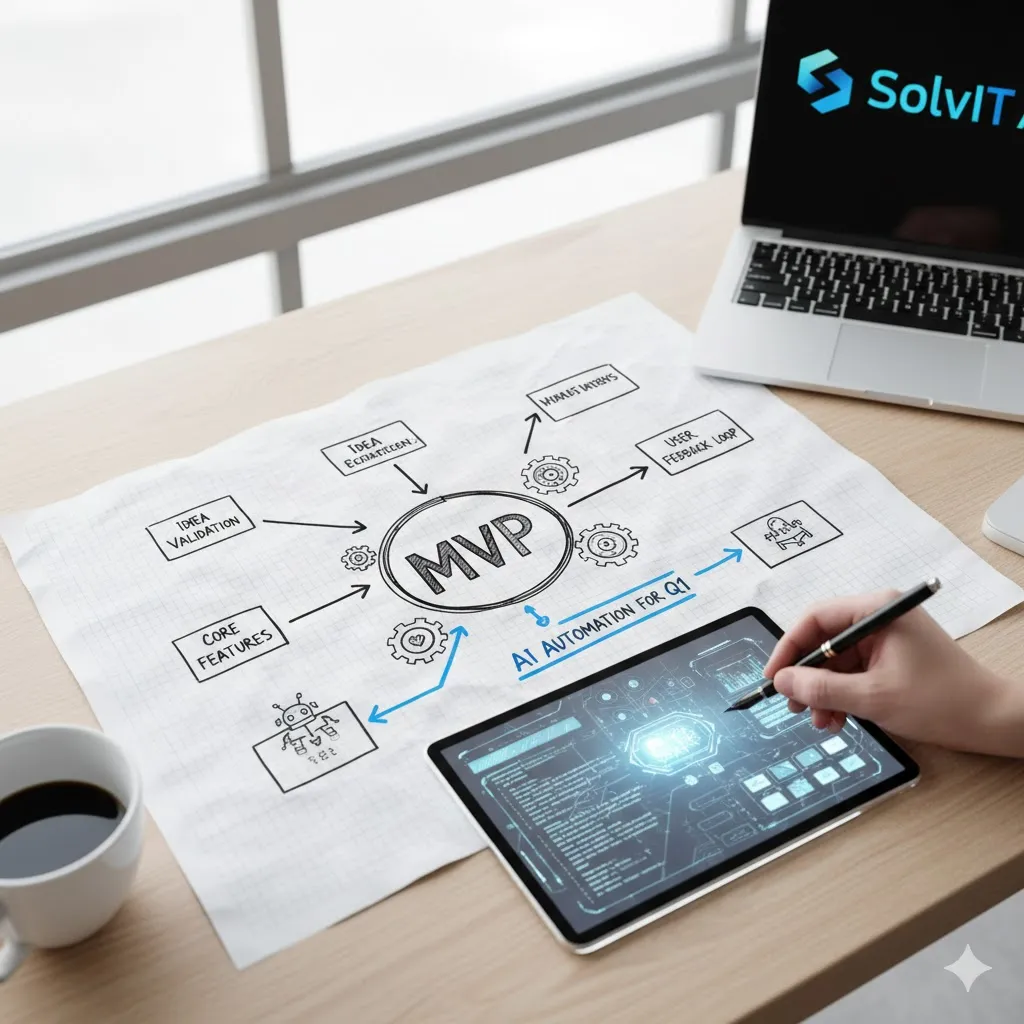
An AI Minimum Viable Product (MVP) is the smallest, most focused version of an AI-powered solution that delivers a measurable business outcome while minimizing development cost and time-to-impact. Unlike full product launches that attempt to solve a broad set of problems, an AI MVP focuses on a single, well-defined hypothesis: can a model or automation reduce friction, save time, or improve decision accuracy for a specific workflow?
The critical distinction: an AI MVP is not a small product. It's a hypothesis test. Its purpose is to generate a confident invest/abandon/pivot decision quickly — not to ship a feature.
The Three Pillars of an AI MVP
1. Start with a concrete metric. Identify a KPI that ties directly to business value — for example, reducing manual triage time by X%, increasing successful auto-classifications by Y points, or improving lead qualification accuracy. This measurable objective shapes data requirements, success criteria, and the evaluation approach.
2. Prioritize signal, not scale. For many enterprise use cases, high-quality labeled examples beat quantity. Spend time curating representative samples, removing noisy records, and ensuring labels reflect real-world operational edge cases. Human-in-the-loop labeling and iterative correction cycles accelerate learning curves and surface ambiguous cases for policy decisions.
3. Architect for rapid iteration. Build a narrow model surface with clear input/output contracts, a sandboxed inference endpoint, and a simple web or API interface for stakeholder review. Instrument everything: collect input distributions, confidence scores, and user feedback. Observability is non-negotiable — it enables fast rollback, targeted retraining, and measurable ROI reporting.
Operational Maturity & Scaling
Operational maturity matters. An MVP that cannot be monitored or that silently degrades damages trust. Implement production safeguards: input validation, fallback behaviors, and alerting for data drift. Keep deployments deterministic and reproducible with versioned data snapshots and model artifacts.
When the MVP demonstrates impact, expand horizontally: add features, increase coverage, and harden pipelines for production scale. Keep decisions data-driven: use A/B tests, offline evaluations, and gradual rollouts. Preserve the learnings — from labeling edge cases to operational best practices — as artifacts that guide the full product roadmap.
Practical Example: Triage Classifier
Rather than launching a full conversational assistant, deliver an automated triage classifier that labels incoming requests and routes them to the right team with suggested priority. This reduces manual sorting time, provides clear signals for model improvement, and offers an immediate cost-saving metric.
In short, an AI MVP maximizes learning per dollar by focusing on a narrow, measurable outcome, investing in quality data and observability, and deploying operational controls that sustain trust and scale. That approach turns early experimentation into repeatable, business-impacting AI products.
When to Build an AI MVP vs. a Full Product
The MVP approach is appropriate when you have a hypothesis about AI value but lack production-grade evidence — when you need to validate that a model can meet your accuracy requirements, that the data you have is sufficient, and that the business unit will actually adopt the output. If you already have validated evidence from a prior deployment, a clear roadmap, and organizational buy-in, you may be able to skip the MVP stage and architect for production directly.
Build an MVP when: the use case is novel (no internal precedent), the data quality is uncertain, the stakeholder is skeptical, or the compliance requirements need to be validated against a real deployment before committing to full build. Build a production system directly when: you have a successful MVP from a related use case, the data pipeline is proven, and the stakeholder has committed to adoption contingent on accuracy targets you're confident you can hit.
The 5 Most Common AI MVP Mistakes — and How to Avoid Them
Mistake 1: Defining Success by Model Accuracy Instead of Business Impact
A model that's 94% accurate on your test set can still deliver zero business value if it's solving the wrong problem. Define success as a business metric change — cost reduced, time saved, revenue increased, error rate lowered. Model accuracy is a proxy; business impact is the goal.
Mistake 2: Building for Scale Before Validating the Hypothesis
Over-engineering an MVP is as common as under-engineering it. Organizations that build distributed, fault-tolerant, multi-tenant architecture for a pilot that hasn't yet proven its value hypothesis burn budget and extend timelines without generating proportional learning. Build the minimum infrastructure needed to collect clean, production-representative signal. Scale after the hypothesis is validated.
Mistake 3: Using Data That Doesn't Represent Production Reality
Training on historical data that was clean, complete, and carefully curated by the data team — and then deploying against messy, real-world production data — is a reliability failure waiting to happen. The MVP data should be sampled directly from the production pipeline, warts and all. You want to discover data quality problems during the MVP, not after you've committed to a production rollout.
Mistake 4: No Feedback Mechanism
An MVP without a feedback loop produces model artifacts but not organizational learning. Every user interaction with the MVP should generate a signal: did the user accept the model's recommendation? Override it? Request a different output? This signal is gold for retraining and for understanding the gap between model output and human judgment.
Mistake 5: Treating the MVP as a One-Time Deliverable
The MVP is not a project with an end date — it's the beginning of a learning loop. The goal of the MVP isn't to ship a feature; it's to validate a hypothesis quickly enough that the organization can make a confident invest/abandon/pivot decision. Build the MVP to be observable, iterable, and disposable if needed. The fastest path to a successful production AI system runs through several failed or redirected MVPs.
SolvIT AI's AI MVP Engagement: What the First 30 Days Look Like
Our MVP engagements are designed to produce a working proof-of-value in 30 days, with a clear decision framework at the end. Here's what we do in each phase:
- Days 1–5: Hypothesis Scoping. We work with the business stakeholder to define the exact KPI being targeted, the acceptable accuracy threshold, the data that's available, and the decision the MVP needs to inform. We document a formal success criterion that both technical and business stakeholders sign off on before any data work begins.
- Days 6–14: Data Assessment & Pipeline. We sample production data, assess quality across the five dimensions (completeness, consistency, timeliness, accuracy, accessibility), and build a minimal data pipeline that extracts, transforms, and loads a training-ready dataset. Data problems discovered here redirect scope before they become model problems. For a deeper look at data readiness, see our AI Readiness Checklist.
- Days 15–23: Model Development & Evaluation. We build a minimal model — often a fine-tuned foundation model or a well-engineered ML pipeline rather than a novel architecture — and evaluate it against the defined success criterion on a held-out test set. We instrument the model output with confidence scores and generate the evaluation report against the pre-defined acceptance threshold.
- Days 24–30: Stakeholder Review & Decision. We deploy the MVP in a sandboxed production environment with a small user group, collect feedback through the structured feedback mechanism, and produce a go/no-go recommendation with supporting evidence: accuracy results, user feedback analysis, cost/benefit projection, and a phased roadmap for production build if the recommendation is go.
Most of our MVP engagements result in a confident go decision — because we've validated the hypothesis before build, not discovered its flaws after. For organizations that want to move from MVP to production, that transition is handled through our Phase II: Custom Agentic Workflows engagement.
Key Takeaways
- An AI MVP is a hypothesis test, not a small product. Its purpose is to generate a confident invest/abandon/pivot decision quickly, not to ship a feature.
- Define success as a business metric change, not a model accuracy score. Accuracy is a proxy; business impact is the goal.
- Use production data from day one. Training on curated historical data and deploying against messy production data is a reliability failure waiting to happen.
- The 5 most common MVP mistakes: accuracy-based success definition, over-engineering before validation, unrepresentative training data, missing feedback mechanism, treating MVP as a one-time deliverable.
- Build an MVP when the use case is novel, data quality is uncertain, stakeholders are skeptical, or compliance requirements need validation against a real deployment first.
- SolvIT's 30-day MVP engagement produces a go/no-go recommendation with accuracy results, user feedback analysis, cost/benefit projection, and a phased production roadmap.
Related reading: AI Readiness Checklist | The Real ROI of Enterprise AI | Phase II: Custom Agentic Workflows | Free AI Assessment